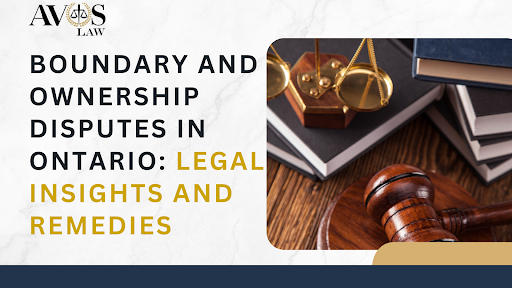
Property ownership is a cornerstone of wealth creation and personal security, but it can also be the source of some of the most contentious legal conflicts. In Ontario, disagreements over property boundaries, ownership rights, and title claims often end up as formal Real Estate Disputes & Litigation under provincial statutes and judicial principles collectively known as Real Estate Law in Ontario.
Whether you’re a homeowner, investor, neighbour, or developer, boundary and ownership disputes can significantly impact your financial interests, property rights, and peace of mind. Understanding how these disputes arise, the legal frameworks that govern them, and the remedies available under Ontario law is essential for protecting your rights and navigating conflict effectively.
This article explores the most common types of boundary and ownership disputes in Ontario, how the legal system addresses them, and how skilled legal counsel — such as AVOS Law — can help individuals and businesses resolve complex property conflicts.
1. What Are Boundary Disputes?
A boundary dispute occurs when adjacent property owners disagree about the precise dividing line between their properties. These disputes can arise from:
- Conflicting survey records
- Inaccurate or outdated property descriptions
- Encroachments such as fences, driveways, or structures
- Changes in natural features that previously defined boundaries
Under Real Estate Law in Ontario, boundary lines are generally established by the deed’s legal description registered with the land registry office. However, when two owners interpret land descriptions differently, conflict arises.
Boundary disputes are a subset of Real Estate Disputes & Litigation because they often require a legal determination of where the property line lies. This typically involves an expert land survey and judicial interpretation of historical title documents.
2. How Ownership Disputes Develop
Ownership disputes revolve around conflicting claims to legal title. These disputes may be caused by:
- Improper or fraudulent transfers
- Undisclosed interests such as liens or encumbrances
- Competing claims by heirs or co-owners
- Title defects due to clerical errors in land records
Unlike boundary issues — which primarily determine where one property ends and another begins — ownership disputes challenge who actually holds the legal rights to a property.
Under Ontario’s legal framework, clear title is essential not only for establishing ownership but also for selling, mortgaging, or developing property. A clouded or defective title can lead to costly litigation to quiet title or clear competing claims, a core area within Real Estate Disputes & Litigation.
3. The Legal Framework: Real Estate Law in Ontario
Ontario’s system of property law is structured around both statute and common law principles. The Land Titles Act and associated registry systems govern how property rights are recorded, transferred, and protected. Title registration serves as public notice of ownership and any charges against it.
When disputes arise, the courts interpret land titles, survey evidence, legal descriptions, and historical documentation to determine:
- Who holds valid title
- Where legal boundaries lie
- Whether any registered interests (like easements or liens) interfere with ownership rights
This legal interpretation happens within the framework of Real Estate Law in Ontario, which balances the interests of private parties, registered interests, and public policy.
4. Discovering and Assessing Title Records
Resolving a boundary or ownership dispute often begins with a thorough examination of title records. Land registrations, historical surveys, and title certificates provide insight into:
- The legal description of property parcels
- Any registered encumbrances, such as mortgages and easements
- Previous transfers of ownership
- Title history that might reveal conflicting claims
Lawyers specializing in real estate disputes conduct this title research early in the process. By identifying discrepancies or competing claims, they can advise clients on legal strategies and whether litigation is necessary.
5. Surveying and Expert Evidence
Title documents alone may not be enough to settle boundary disputes. An up-to-date land survey is often essential to accurately define the boundary lines based on coordinates, measurements, and registered descriptions.
Because boundary disagreements require technical precision, courts frequently rely on expert surveyors to present:
- Updated boundary maps
- Reconstructions of property lines
- Evidence of encroachments
Survey evidence is especially valuable in Real Estate Disputes & Litigation because it provides a neutral, professional assessment that judges can use to interpret conflicting claims.
6. Negotiation and Alternative Dispute Resolution (ADR)
Not all boundary or ownership disputes must go to trial. Many can be resolved through negotiation between parties or through structured alternative dispute resolution methods such as:
a. Mediation
A neutral third-party mediator helps disputing owners reach an amicable solution without resorting to litigation.
b. Arbitration
An arbitrator hears each side’s evidence and renders a binding decision, often more quickly and privately than a court process.
Alternative approaches like mediation and arbitration can be effective in reducing time, cost, and emotional stress. They also allow parties to preserve neighbourly relations when ongoing cooperation is desirable.
7. Litigation: When Court Action Is Needed
When informal or alternative dispute resolution fails — or when the dispute involves significant financial or legal stakes — formal litigation may be necessary. Litigation under Real Estate Law in Ontario involves several stages:
a. Filing a Claim
The plaintiff initiates a lawsuit by filing a statement of claim outlining the nature of the boundary or ownership dispute.
b. Discovery
Both sides exchange evidence and undertake examinations for discovery, clarifying the strengths and weaknesses of their claims.
c. Trial
At trial, legal arguments, survey evidence, title records, and witness testimony are presented before a judge.
d. Judgment and Remedies
The court issues a binding decision, which may include orders such as:
- Quiet title to confirm legal ownership
- Declaration of boundary line
- Injunctions preventing further encroachment
- Monetary compensation where losses are proven
Litigation is a formal process and often the last resort. It requires experienced legal representation to navigate procedural rules, interpret complex property law, and present evidence effectively.
8. Remedies in Ontario for Boundary and Ownership Disputes
Ontario courts can award several types of remedies depending on the nature of a dispute:
Quiet Title
In an ownership dispute, quiet title actions clarify who holds legal title and suppress competing claims, ensuring the owner’s rights are recognized and enforceable.
Boundary Line Declarations
Judges can determine the exact legal boundary between neighbouring properties based on survey and title evidence.
Injunctions
If one party’s actions are causing ongoing harm — such as ongoing encroachment — the court can order them to stop those actions immediately.
Damages
In some cases, monetary compensation is awarded to cover losses caused by boundary encroachment or other disputes.
These remedies are part of the legal tools available for resolving Real Estate Disputes & Litigation under Real Estate Law in Ontario.
9. Costs and Strategic Considerations
Real estate litigation is often resource-intensive. Parties must consider:
- Legal fees
- Expert witness costs, such as surveyors
- Court filing fees
- Time and emotional investment
An experienced lawyer helps clients assess whether the potential benefit of litigation outweighs the cost. They may also negotiate settlements that avoid extended litigation while preserving core rights.
10. Preventive Measures to Avoid Disputes
Many property disputes can be avoided with proactive legal planning and documentation:
Accurate Surveys Before Purchase
Commissioning an updated survey before closing can reveal hidden boundary issues early.
Clear Title Searches
Comprehensive title checks can prevent ownership conflicts by ensuring all interests are disclosed before a sale.
Well-Drafted Contracts
Real estate contracts should explicitly define boundaries, easements, and shared rights to reduce ambiguity.
Taking preventive steps under Real Estate Law in Ontario helps protect investors and property owners from costly legal battles later.
11. How AVOS Law Supports Property Owners and Investors
Boundary and ownership disputes require a strategic blend of legal knowledge, technical evidence, and negotiation skill. AVOS Law offers comprehensive legal support for individuals and businesses navigating these complex challenges. Their services in real estate dispute resolution include:
- Detailed Title Examination: Lawyers at AVOS Law assess title records, historical documents, and registered interests to uncover potential issues early.
- Expert Advocacy in Negotiation: Skilled negotiators help resolve conflicts before they escalate into full-blown litigation.
- Representation in ADR and Court: Whether through mediation, arbitration, or formal litigation, AVOS Law advocates for clients’ rights under Real Estate Law in Ontario.
- Strategic Legal Planning: Their team creates tailored legal strategies that align with client goals, financial considerations, and long-term property interests.
With a commitment to personalized legal solutions and proactive advocacy, AVOS Law assists clients in navigating the legal landscape of boundary and ownership disputes with confidence and clarity.
About AVOS Law
AVOS Law is a dedicated Ontario law firm providing comprehensive legal services across real estate, business law, estate planning, immigration, and related areas. The firm’s legal team focuses on protecting clients’ rights through tailored strategies, careful documentation, and skilled advocacy. AVOS Law assists with residential and commercial property issues — including boundary disputes, title concerns, purchase and sale transactions, mortgage and refinancing matters, and lease negotiations — helping clients navigate the legal complexities of property ownership. Their client-centered approach emphasizes trust, integrity, and personalized service, ensuring that each case is addressed with clarity, professionalism, and attention to detail.